The Internet Doesn’t Run on Algorithms Alone BUT It Runs on Fandom
What Ogilvy’s Fandom Flux report reveals about identity, creators, and why participation now beats promotion.

Quick context before we dive in: this post is based on “Fandom Flux: Codes for Growth with Gen Z & Gen Alpha,” a 2025 report from Ogilvy Consulting, written by Reid Litman. It’s one of the rare industry reports that actually understands fandom as lived culture and not just a marketing buzzword.
I’ve personally spent an embarrassing amount of my life inside fandoms (Discords, Tumblr, AO3, fan edits, lore threads, you name it!). So reading this report felt less like new information and more like finally seeing the internet described accurately in a deck.
If you work in brand, marketing, or growth, here’s the version you actually need.
First Things First: Fandom Is Not a Hobby Anymore
The biggest idea in the report is also the simplest:
Fandom is how Gen Z and Gen Alpha organize their lives online.
Not as a side interest.
Not as entertainment only.
As identity, community, and connection.
The report shows that:
86% of Gen Z identify as fans
81% prefer being known by their interests, not demographics (swifties, arianators, cinephiles, you name it!)
Half say fandom helps them make sense of the world
Translation: fandoms are doing the emotional work that schools, churches, neighborhoods, and media used to do.
If you’re a brand trying to build community, you’re not starting from scratch but you’re stepping into something that already exists and already matters.
There Is No Mainstream, Only Many Group Chats
Here’s a stat that explains basically everything confusing about culture right now:
91% of 18–25-year-olds say there is no single pop culture mainstream.
Instead of one big cultural stage, we now have:
Thousands of smaller worlds
Each with their own references, rules, and heroes
And incredibly high emotional investment
Think less Super Bowl ad and more very intense group chat that never shuts up.
This is why brands keep missing. They’re aiming for mass appeal in a world that now runs on micro-belief systems.
Fans Aren’t Watching. They’re Playing.
One of the report’s strongest points is that fans are no longer passive.
They:
Make edits
Write theories
Build wikis
Design outfits
Run accounts
Sell merch
Moderate communities
According to the data:
64% of Gen Z say they’re creators
Most spend more time with fan-made content than official content
A useful mental shift for marketers:
Fans don’t want to be marketed to, they want room to do something.
That’s why many a pop star’s tours exploded online. The label didn’t tell fans what to post. Fans turned the tour into an entire creative ecosystem on their own.
The brand’s job? Don’t get in the way.

Important PSA: Brands Don’t Own Fandoms
The report quietly lays out what I’d call the unspoken rules of fandom:
Fans were here first
Fans talk to each other, not just to creators (seriously, I have friends from my teenage fandom days in parts of the world I have not even been to, all thanks to fandoms!)
Influence goes both ways
Control is always shared
If a brand shows up acting like it owns the moment, fans feel it instantly. And when fans reject something, they don’t usually complain but they just stop engaging.
Which is much worse.
Why Old Marketing Logic Breaks Here
The report includes a very helpful Then vs Now comparison.
Then
Fans consumed
Brands broadcast
Access = power
Now
Fans participate
Culture spreads sideways
Creativity = power
This explains why:
Fan edits outperform trailers
Creator breakdowns beat official streams
Unofficial content drives discovery
Culture is assembled in public.
Platforms Aren’t the Point, Behavior Is
Another smart thing the report does: it doesn’t pretend fandom belongs to TikTok or Discord.
Platforms are just different rooms in the same house:
TikTok = discovery
Discord = hanging out
AO3 = storytelling
Substack = deep dives
Patreon = sustained support
For brands, this matters because showing up in the wrong way in the wrong room feels awkward fast.
(If you wouldn’t interrupt a book club to run an ad, don’t do it digitally either.)
When Brands Get It Right, It Looks Effortless
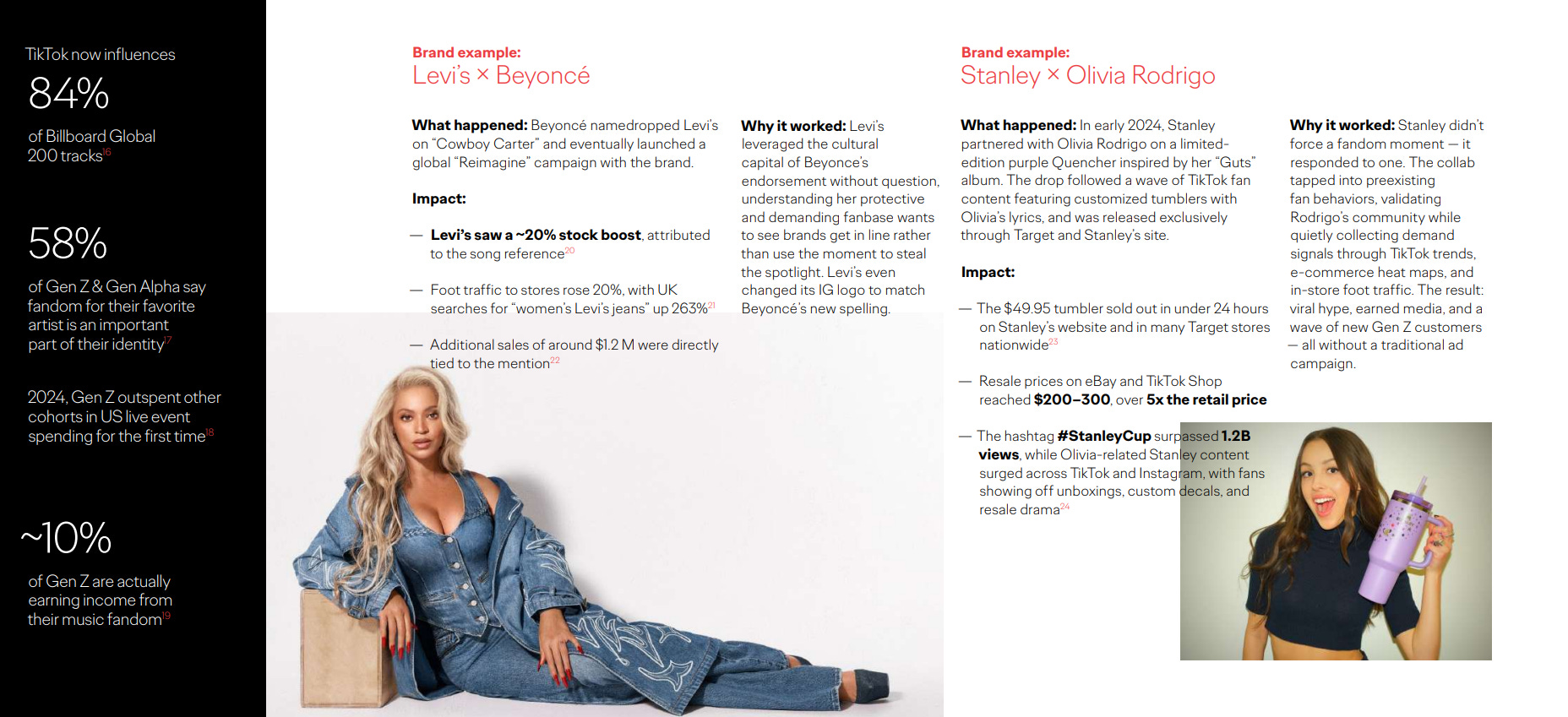
The successful examples in the report all share one thing: they followed fans instead of leading them.
Stanley noticed fans customizing tumblers, then collaborated
Levi’s didn’t outshine Beyoncé but they quietly aligned
Maybelline turned makeup into a playable item in Roblox
Savage X Fenty made shopping feel like a fan event
None of these tried to start a fandom. They plugged into existing energy.
One Big Insight Marketers Should Steal
The report maps fandoms by:
Emotional tone (comforting → chaotic)
Participation style (protective → remix-friendly)
This is huge.
Some fandoms love remixing and brand play.
Others guard their space fiercely.
Smart brands know the difference before they show up.
So What Should Brands Actually Do?
The report lands on three simple but powerful ideas:
Experiences: smooth the chaos, amplify the joy
Access: give fans closer proximity, not louder ads
Belonging: create spaces where fans feel seen
Or, more simply:
Don’t interrupt fandom. Support it.
Final Thought
Fandom is the structure underneath modern culture.
Brands that treat it like a campaign will burn out fast.
Brands that treat it like a relationship might actually earn a place.
And if you want relevance with Gen Z and Gen Alpha, there’s no shortcut around this work but you have to meet fans where meaning is already being made.
SOURCE
OGILVY
